Jazz Magazine [France]: Three Questions for Aruán Ortiz
In an interview with Aruán Ortiz for the December/January issue of Jazz Magazine (France) he talks about his work with the James Brandon Lewis Quartet and inspiration for his latest album, Creole Renaissance.
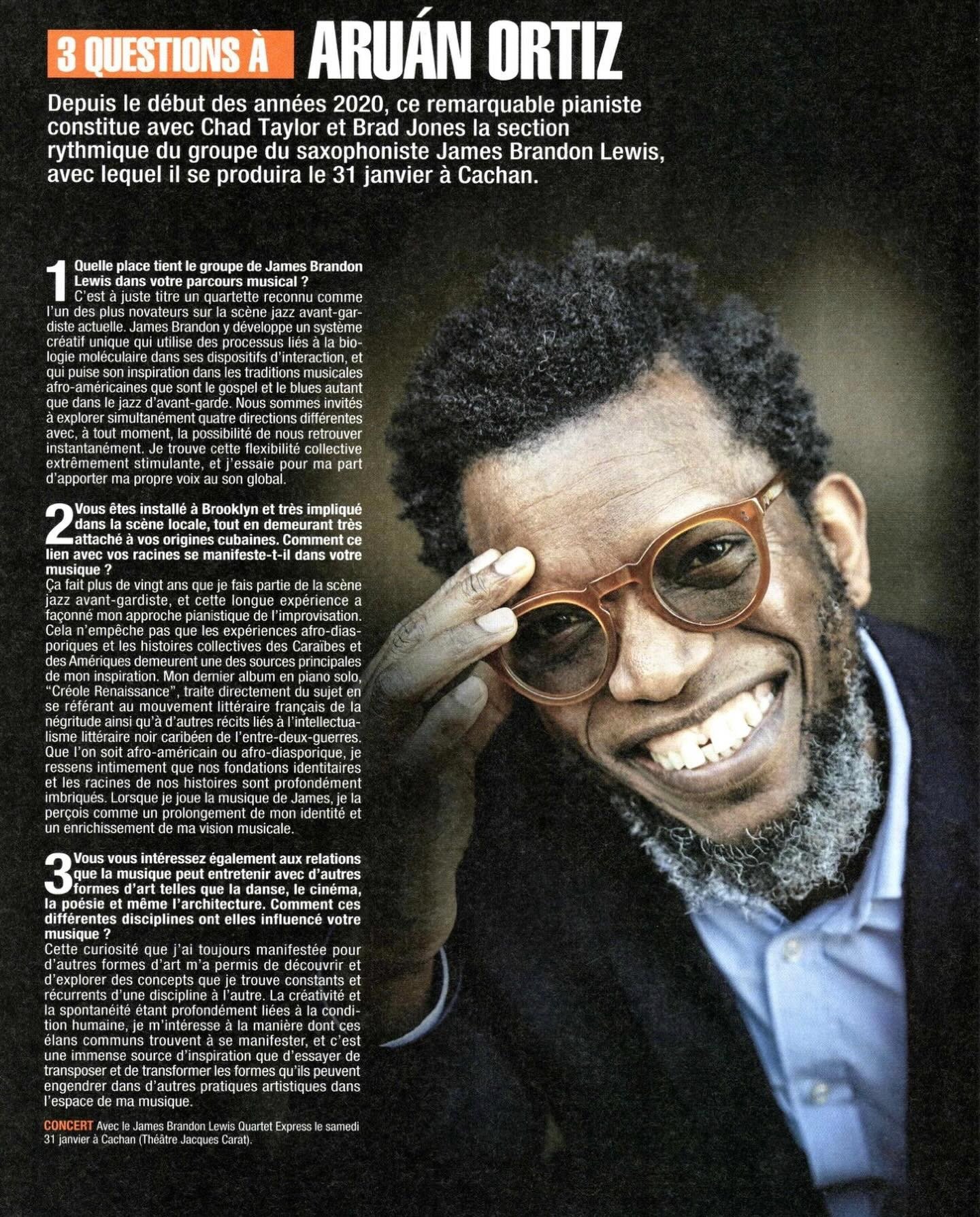
"3 QUESTIONS FOR
ARUÁN ORTIZ
Since the early 2020s, this remarkable pianist has formed the rhythm section of saxophonist James Brandon Lewis's group with Chad Taylor and Brad Jones, with whom he will perform on January 31st in Cachan.
1. What place does James Brandon Lewis's group hold in your musical journey?
It is rightly recognized as one of the most innovative quartets on the current avant-garde jazz scene. James Brandon has developed a unique creative system that uses processes related to molecular biology in its interaction mechanisms, and draws its inspiration from African-American musical traditions such as gospel and blues as much as from avant-garde jazz. We are invited to explore four different directions simultaneously, with the possibility of instantly coming together again at any moment. I find this collective flexibility extremely stimulating, and I try, for my part, to bring my own voice to the overall sound.
2 .You're based in Brooklyn and very involved in the local scene, while remaining deeply connected to your Cuban roots. How does this connection to your roots manifest itself in your music?
I've been part of the avant-garde jazz scene for over twenty years, and this long experience has shaped my approach to improvisation as a pianist. That doesn't mean that Afro-diasporic experiences and the collective histories of the Caribbean and the Americas aren't a primary source of inspiration. My latest solo piano album, "Creole Renaissance," directly addresses this subject by referencing the French literary movement of Negritude as well as other narratives related to Black Caribbean literary intellectualism between the two world wars. Whether one is African American or Afro-diasporic, I feel deeply that our foundations of identity and the roots of our histories are profoundly intertwined. When I play James's music, I see it as an extension of my identity and an enrichment of my musical vision.
3. You are also interested in the relationships between art forms such as dance, film, poetry, and even architecture. How have these different disciplines influenced your music?
This curiosity I've always had for other art forms has allowed me to discover and explore concepts that I find constant and recurring from one discipline to another. Since creativity and spontaneity are deeply linked to the human condition, I'm interested in how these shared impulses find expression, and it's a tremendous source of inspiration to try to transpose and transform the forms they can generate in other artistic practices within the space of my music.